
A steel import order should start with a complete product list, a named destination and a clear division of responsibilities. The cheapest product quotation is not necessarily the lowest delivered project cost.
This guide helps buyers prepare an order from China to an African destination. It is a supplier and shipment-planning checklist, not a single customs procedure for the continent. Confirm the exact product classification, import requirements and charges with the destination customs authority or your appointed broker before committing to shipment.
In this guide
- Order and delivery details
- Comparable specifications
- Commercial terms
- Shipment documents
- Loading and schedule
- Destination costs and release
- Send an enquiry
1. Define the order and the delivery point
- Identify the importing company, destination country, discharge port and final delivery location.
- Prepare a bill of quantities (BOQ) with a separate line for every product and size.
- State the required site date, whether partial shipments are acceptable and who will receive and unload the goods.
- List project approvals, inspection requirements and documents that must be available before dispatch.
For a project with several material packages, use the construction-project preparation checklist to separate technical approval, procurement and site-delivery milestones.
2. Make product quotations comparable
| Item to define | Information to put in the enquiry |
|---|---|
| Product and application | Pipe, fitting, section, plate or fabricated part; intended service and drawing reference. |
| Technical specification | Exact standard and grade, dimensions with units, wall thickness where relevant, length and tolerances. |
| Finish and processing | Coating requirements, pipe ends, cutting or fabrication details, and current drawing revision. |
| Quantity and pricing basis | Pieces, metres or metric tonnes; identify whether weights are measured or calculated. |
| Quality evidence | Required manufacturer documents, inspection scope and any project-specific approval. |
| Packing | Bundle identification, package limits and any handling or storage constraints. |
Do not treat a nominal pipe size as a complete specification. A wall-thickness schedule is also not a product certification. Ask suppliers to identify any deviation or proposed substitution instead of silently changing the BOQ.
3. Compare the same commercial scope
Write the agreed Incoterms® rule, the named place or port and the version into the quotation and contract. Ask which local handling charges, documents and optional services are included. A three-letter term alone is not a complete delivered-cost breakdown.
| Term or handover | Point to clarify |
|---|---|
| EXW | Confirm pickup, loading and export-clearance arrangements; do not assume that a factory price includes them. |
| FCA | Name the exact carrier handover point and agree the associated handling scope. |
| FOB | For sea or inland-waterway carriage, delivery and normal risk transfer are on board the vessel at the shipment port, not simply on arrival at a port gate. |
| CIF | The seller arranges freight and insurance to the named destination port, but normal risk transfer is on board at shipment. It is not an all-inclusive site-delivered price. |
The ICC Incoterms® 2020 rules distinguish freight payment from risk transfer. For container cargo handed to a carrier before vessel loading, discuss an appropriate multimodal term, such as FCA or CIP, rather than choosing FOB or CIF automatically. Check insurance scope and exclusions.
4. Agree a document checklist before production
Name the contracting seller, exporter and destination importer, and clarify the role of any agent. A supplier checklist helps the parties coordinate; it does not determine the full legal requirements for a particular shipment.
| Document or record | Buyer review point |
|---|---|
| Contract or confirmed order | Correct parties, product specification, quantity, commercial terms and agreed document list. |
| Manufacturer quality documents | Required tests and traceability to the supplied product or batch, as specified in the order. |
| Export licence, when applicable | Ask the exporter to check the exact goods against current Chinese requirements. See the 2026 steel export-rule guide. |
| Commercial invoice and packing list | Consistent descriptions, units, quantities, weights and package identification. |
| Bill of lading or transport document | Check draft party details, ports and cargo particulars before final issue. |
| Origin or destination-specific documents | Confirm whether certificates, inspections, permits or other documents are required for this product and destination. |
5. Confirm loading feasibility and the shipment schedule
Container selection depends on the packed dimensions, weight distribution, equipment limits, securing plan and inland-route restrictions. Do not use a fixed tonnes-per-container figure for every order. Long items, heavy bundles and mixed cargo need a loading plan reviewed by the responsible logistics team.
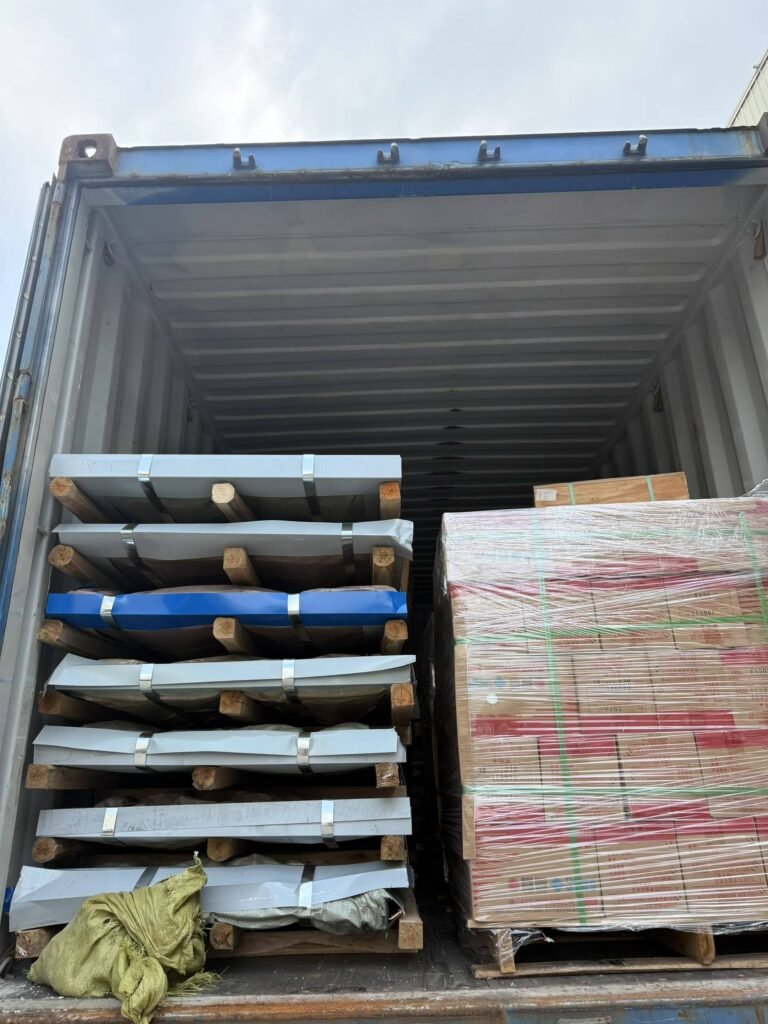
Mixed loading can be considered when the products, packaging, readiness dates and handling requirements are compatible. Combining products is not automatically cheaper: compare the cost of consolidation, extra handling, storage and any delay to urgent items.
Request a dated schedule covering technical approval, material readiness, inspection, booking, departure, arrival and destination release. Ocean transit is only one part of the timetable. Ask the forwarder to confirm the proposed route, transshipment arrangements and booking conditions rather than relying on a generic sailing-time range.
6. Check destination costs and release requirements
Before booking, ask the importer or broker to confirm the applicable classification, documentation, taxes or duties, product checks and any restrictions for the destination and shipment date. Identify who will pay destination handling, storage, customs clearance, inland transport and unloading. Do not assume that arrangements for one African country apply to another.
7. Send a complete enquiry
CanHope combines its own galvanized-pipe manufacturing with sourcing and project-material coordination. Mixed packing and export-shipment coordination are reviewed against the actual order and loading plan. The container-loading photographs show handling examples, not a guarantee of capacity, destination approval or delivery time.
Send your BOQ, specifications, destination and required delivery date to info@canhopesteel.com. Include the document and inspection requirements already confirmed by your project team and destination broker.