
Grooved pipe fittings are mechanical piping components used to redirect, branch, reduce or terminate a pipeline. Compatible couplings join the grooved ends; gaskets provide the seal, and the coupling housings and hardware retain the joint.
The method can reduce on-site welding where the design permits it. Correct selection still depends on the pipe, groove, fitting, coupling, gasket and service conditions. For product types, see our grooved pipe fittings range.
In this guide
- 1. How a grooved joint works
- 2. Common fitting types
- 3. Applications and benefits
- 4. What to confirm before ordering
- 5. Common questions

1. How does a grooved pipe joint work?
A groove is formed or machined near each pipe end. In a typical grooved joint, a gasket seals around the pipe ends and the coupling housings engage the grooves. Hardware secures the assembly. The exact preparation, assembly and inspection sequence comes from the selected manufacturer’s instructions, not from this introductory description.
- Pipe ends with the specified groove geometry.
- A coupling of the required type and size.
- The correct gasket grade and profile for the service.
- Matching housings, bolts and nuts or other specified hardware.
Victaulic’s grooved-technology overview explains these components and distinguishes rigid and flexible couplings. It is a manufacturer reference, not evidence that another brand’s components are interchangeable.

2. Common types of grooved pipe fittings
Grooved couplings
Couplings connect compatible grooved ends. Rigid couplings restrain joint movement; flexible couplings permit limited movement within their documented limits. The required type follows the system design, not the assumption that “flexible” is always better.

Grooved elbows
Elbows change the direction of a pipeline. Specify the angle, size and end connections. Common configurations include 90-degree and 45-degree elbows.

Grooved tees
Tees form branch connections. Identify every connection size and whether an equal or reducing tee is needed.

Grooved reducers
Reducers join different sizes. State both sizes and whether the design requires a concentric or eccentric arrangement.

Mechanical outlets, flange adapters and caps
- Mechanical outlets: create a branch through a prepared opening in a compatible main pipe. Confirm the permitted pipe range, outlet connection and preparation instructions.
- Flange adapters: connect a grooved end to an appropriate flanged component. Check the mating flange dimensions and manufacturer limitations. A threaded flange is not a grooved flange adapter.
- Caps: close a pipe end using the specified cap and coupling combination. Do not infer test or temporary-closure suitability from appearance.
3. Applications and practical benefits
Grooved systems are used in applications such as fire protection, water services, HVAC and industrial piping when the selected products are suitable for the specified service. These uses do not mean every grooved fitting is approved for every system.
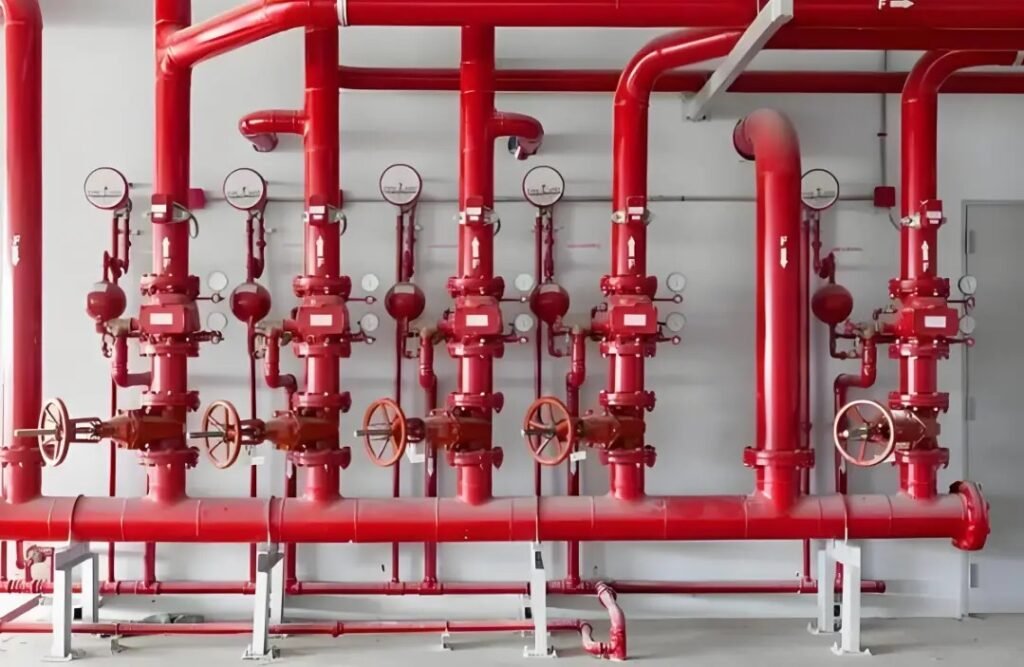
- Less on-site welding: a specified mechanical joint can reduce welding work at that connection.
- Access for maintenance: suitable joints may be disassembled for planned maintenance after the system has been safely isolated.
- Layout changes: compatible components can support alterations, subject to design review and the manufacturer’s instructions.
Installation time, maintenance effort and cost depend on site conditions and the complete system. No universal speed or cost saving is assumed here.
4. What should buyers confirm before ordering?
| Check | Information to confirm |
|---|---|
| Product identification | Manufacturer, exact model, fitting type and quantity. |
| Dimensions | Nominal size, actual pipe OD, wall thickness and every branch/reducer connection size. |
| Groove compatibility | Groove system/profile and roll- or cut-groove preparation allowed for that pipe. |
| Service | Fluid and additives, wet/dry conditions, operating temperature and required pressure. |
| Materials | Fitting material, finish, gasket grade/profile and compatible hardware. |
| Compliance | Required pipe standard and current listing/approval evidence for the exact offered model and sizes. |
| Shipment | Piece counts, packaging, destination and any related items that must arrive together. |
Groove dimensions are not universal. For example, the Victaulic OGS specification identifies OD, gasket-seat, groove and wall-thickness requirements for its covered products. Do not copy those limits to another manufacturer without evidence of compatibility.
Some fittings can be offered with UL Listing and/or FM Approval, depending on the exact manufacturer, model and size. Request and check the corresponding evidence through UL Product iQ or the FM Approval Guide. A catalogue logo does not extend to every fitting, pipe or valve in an order.

5. Common questions
Are grooved fittings suitable for fire sprinklers?
Only when the specified assembly, service and required approvals match the project design and the approving authority’s requirements. A grooved connection or red finish alone is not proof of suitability.
Do grooved connections require welding?
The grooved joint itself is mechanically assembled. Other parts of the system may use welded, threaded or flanged connections; follow the approved drawings.
What should I send with an enquiry?
Send the BOQ, pipe specification, connection details, service conditions and required approval documents. Include all sizes for tees and reducers, not just the main-pipe size. Enquiries: info@canhopesteel.com.