
“BS 1387 galvanized pipe” appears in legacy drawings and purchasing enquiries. Before pricing it, establish whether the buyer needs the historical specification or a current project-approved alternative. The standard, series, dimensions, coating and end connections must all be clear.
BS 1387:1985 is withdrawn. BSI’s record gives a withdrawal date of 1 June 2006, and BSI identifies BS EN 10255 as its replacement. Replacing a specification in a purchase order still requires the project’s approval; the names are not interchangeable certificates.
In this guide
- 1. Resolve the standard and edition
- 2. Read size and series correctly
- 3. Confirm ends and connections
- 4. Specify galvanizing separately
- 5. Length, packing and documents
- 6. Prepare the enquiry
1. Resolve the standard and edition first
BS 1387 was a British specification for screwed/socketed steel tubes and plain-end tubes suitable for welding or threading. BS EN 10255 addresses non-alloy steel tubes suitable for welding and threading. For a new enquiry, record the exact required standard and edition rather than writing only “BS pipe”.
If the drawing still says BS 1387, ask the designer or purchaser whether a current specification is acceptable. Record any approved deviation before production. A supplier’s statement that two products are “equivalent” is not enough to resolve differences in dimensions, grade, testing, tolerances or documentation.
2. How to compare size, medium series and heavy series
A nominal diameter or inch designation is not the measured outside diameter. Likewise, “medium” and “heavy” describe a wall-thickness series within a specified standard, not a pressure class. Compare the actual OD and specified wall thickness for each line item.
| Field | What to check |
|---|---|
| Nominal size | DN or inch designation exactly as required by the project. |
| Outside diameter | Specified OD in millimetres and its permitted tolerance. |
| Series and wall | Medium/heavy or other specified series, plus nominal wall thickness and tolerance. |
| Length | Ordered piece length and its tolerance. |
| Unit mass | Applicable nominal mass or weighed basis; whether galvanizing and sockets are included. |
| Connection dimensions | Compatibility with the specified thread, groove or mating fitting. |
At a given size within the same standard, a heavy-series tube generally has a thicker wall and greater nominal mass than its medium-series counterpart. That does not by itself establish a permitted working pressure or a guaranteed longer service life. Material, temperature, joints, corrosion allowance and the design requirements must also be considered.
Use the controlling standard and the proposed manufacturer’s dimension sheet for numeric values. A general website chart should not become the acceptance table for an order unless its edition, units and tolerances have been checked. See our galvanized steel pipe information and request the exact quotation schedule.
3. Plain, threaded, socketed or grooved ends
- Plain end: specify whether the project needs square-cut or another preparation. Further welding or grooving must be allowed by the pipe and connection specification.
- Threaded end: state the thread standard, end arrangement and protection requirements. Do not mix different thread systems based on nominal size alone.
- Threaded and socketed: identify the matching socket/coupling requirements and quantity.
- Grooved end: specify the groove system and preparation method, with compatibility checked against the actual pipe wall and coupling.
Agree how exposed or processed surfaces are treated, and which inspection records confirm the finished ends. End preparation is not evidence of approval for a particular service.
4. Specify galvanizing separately
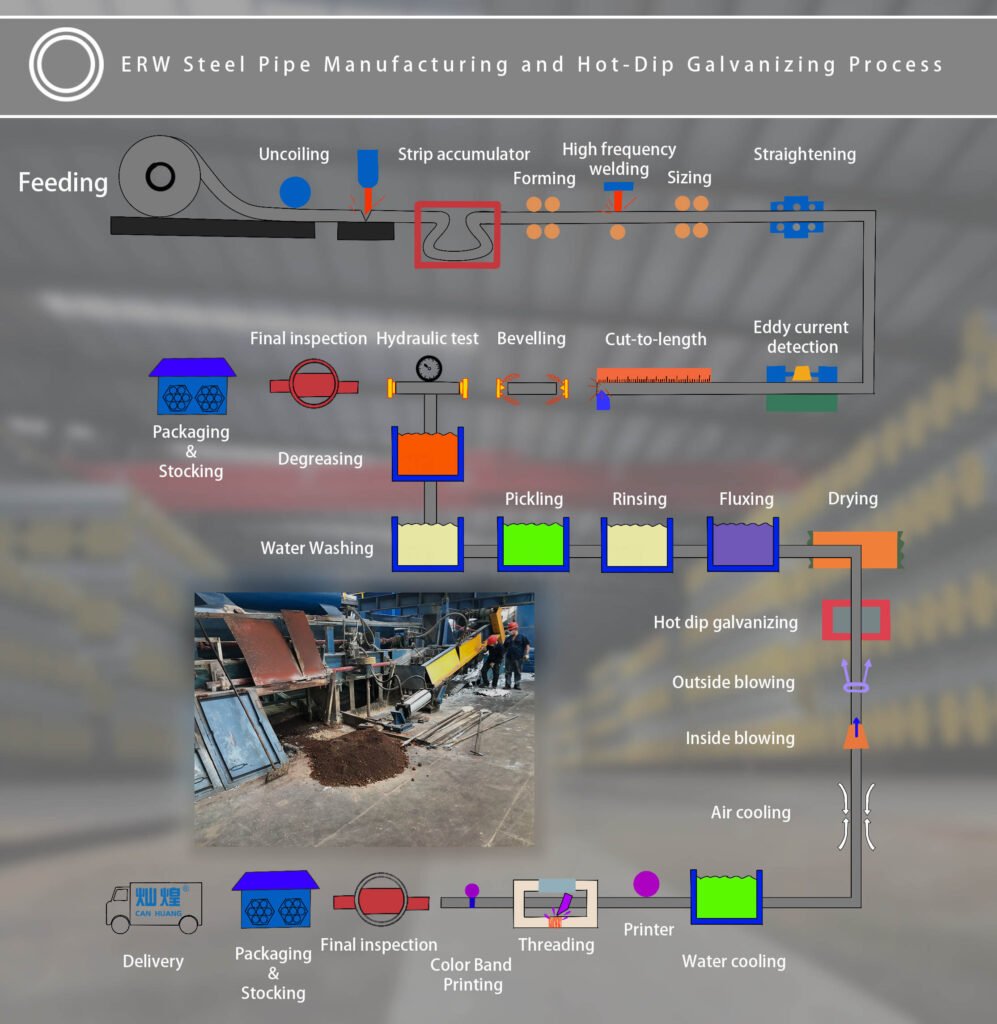
State whether the finished tube is to be galvanized after fabrication or made from previously galvanized material. Record the coating standard, coating requirement, measurement basis and permitted repair procedures. Do not assume an unconfirmed “standard stock” zinc mass applies to the offered batch.
The American Galvanizers Association’s batch-galvanizing explanation describes zinc coating formed on fabricated steel and requirements that depend on the relevant product category and thickness. It is background on the process, not a test report for a pipe shipment.
5. Length, packing and acceptance documents
Confirm actual piece lengths, bundle dimensions and loading requirements before selecting transport. A nominal 6 m or 5.8 m description does not by itself confirm fit, payload or safe loading for a specific container. Request an order-specific packing plan.
For acceptance, agree the documents and checks before production: product identification, dimensional records, material/test certificates where required, coating results and the specified end-preparation checks. Required test methods and acceptance limits must come from the purchase specification, not a generic article.
For water, structural or fire-protection use, have the responsible designer confirm suitability for that service. A BS/EN tube designation alone is not a fire-system approval, a potable-water approval or a structural design check.
6. What to include in a BS 1387 enquiry
- The drawing or purchase-specification reference and whether an alternative standard is permitted.
- Exact standard/edition, grade, nominal size, actual OD, series and wall thickness.
- Length, quantity, tolerances and requested unit-weight basis.
- Coating requirements and plain, threaded, socketed or grooved ends.
- Required product identification, inspection and certification documents.
- Packing, destination and delivery terms.
Send the specification and quantity schedule to info@canhopesteel.com. Confirm the offered product, any deviations and the supporting documents before accepting the quotation.